
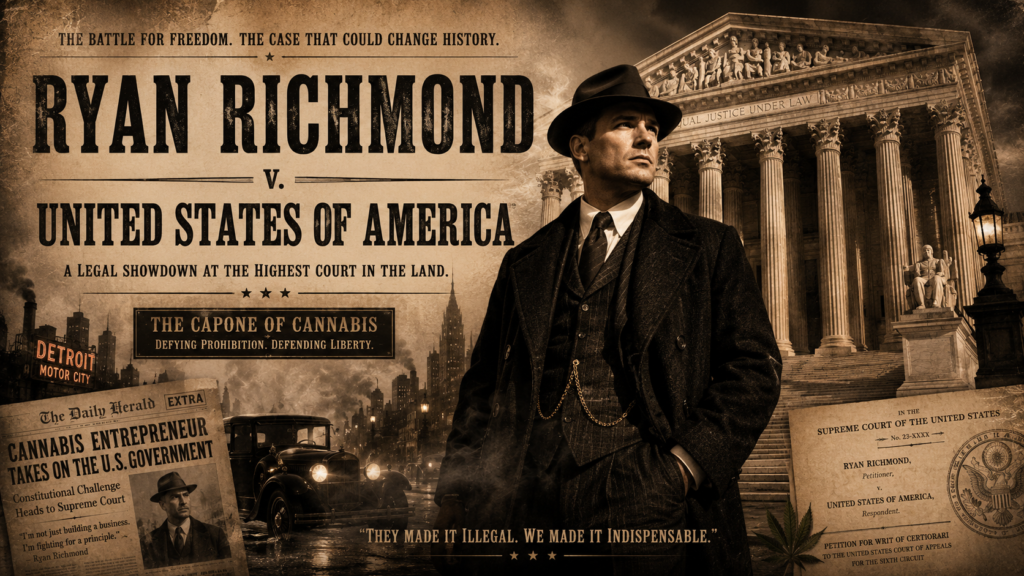
Petition for Writ of Certiorari
QUESTIONS PRESENTED
Whether 26 U.S.C. § 280E —which denies ordinary and necessary business deductions to enterprises trafficking in Schedule I controlled substances —may constitutionally be applied to a state- authorized marijuana business when, in the two decades since Gonzales v. Raich , Congress and the States have abandoned a uniform federal prohibition, and marijuana’s Schedule I classification no longer serves the Commerce Clause, the Necessary and Proper Clause, or Congress’s Taxing Power?
READ US SUPREME COURT PETITION HERE
No. 25- 5412
Supreme Court of the United States
RYAN RICHMOND ,
Petitioner,
v.
UNITED STATES OF AMERICA ,
Respondent.
_______________________________
ON PETITION FOR CERTIORARI
TO THE UNITED STATES COURT OF APPEALS
FOR THE SIXTH CIRCUIT
_______________________________
PETITION FOR WRIT OF CERTIORARI
STUART G. FRIEDMAN
Friedman Legal Solutions, PLLC
26777 Central Park Blvd,, #300
Southfield, MI 48076
Counsel for Petitioner
LEGAL PRINTERS LLC ! Washington, DC ! 202-747-2400 ! legalprinters.com
Page 2 of 49
Page 3 of 49
iiRELATED PROCEEDINGS
The District Court proceeding was in the United
States District Court for the Eastern District of
Michigan. The issue presented in this petition was
not presented to the District Court. The case is
United States v. Richmond , 21-cr-20209
The undersigned successor counsel filed a notice of
appeal presented the issue to the Sixth Circuit.
inUnited States v. Richmond , Sixth Circuit No. 25-
1525 (docket Jun. 4, 2024). The opinion was dated
January 30, 2025. Rehearing en banc was denied March 19, 2025.
Page 4 of 49
iiiTABLE OF CONTENTS
Page No.
QUESTIONS PRESENTED ……………………………… i
RELEVANT PROCEEDINGS ………………………….. ii
TABLE OF CONTENTS …………………………………. iii
TABLE OF AUTHORITIES ……………………………. vi
OPINIONS BELOW ………………………………………… 1
STATEMENT OF SUBJECT MATTER AND
APPELLATE JURISDICTION …………………………. 1
CONSTITUTIONAL AND STATUTORY PROVISIONS INVOLVED ………………………………. 1
STATEMENT OF THE CASE ………………………….. 2
REASON FOR GRANTING WRIT ……………………. 9
I. THIS COURT SHOULD DECIDE
WHETHER § 280E CANCONSTITUTIONALLY BE
APPLIED TO PETITIONER,
BECAUSE MARIJUANA’S
SCHEDULE I CLASSIFICATION
CANNOT BE SUSTAINED
UNDER THE COMMERCECLAUSE, THE NECESSARY AND
PROPER CLAUSE, OR THE
TAXING POWER—AND THE
QUESTION WARRANTS REVIEW
EVEN THOUGH IT WAS NOT
RAISED BELOW. …………………………. 9
Page 5 of 49
ivA. A Brief History of Marijuana
Regulation. ………………………. 10
B. Section 280E of the Tax
Code. ……………………………….. 13
C. Section 280E Cannot be
Justified as a Commerce
Clause Measure . ……………….. 16
D. The Classification ofMarijuana as a Schedule I
Controlled Substance and
Thus Subject to 280E
Cannot be Justified Under
the “Necessary and Proper”
Clause (Including the
Taking Power). …………………. 19
E. Section 280E Cannot be
Justified Under the TaxingPower. ……………………………… 22
F. This Court Should Resolve
the Merits of Petitioner’s
Facial Constitutional
Challenge to § 280E, Which
May Be Raised for the First
Time on Appeal in
Exceptional Cases and PureQuestions of Law. ……………… 28
CONCLUSION ……………………………………………… 36
Page 6 of 49
vAPPENDIX :
Appendix A – Opinion of the United States
Court of Appeals for the Sixth Circuit,
Filed January 30, 2025 ………………………….. 1a
Appendix B – Order of the United States
Court of Appeals for the Sixth Circuit
Denying En Banc Rehearing, Filed
March 2025 …………………………………………. 13a
Appendix C – Order of the United States
Supreme Court Extending Time to File Certiorari Petition ………………………… 14a
Page 7 of 49
viTABLE OF AUTHORITIES
Federal Cases
Alexander v. Aero Lodge No. 735, Int’l Ass’n of
Machinists & Aerospace Workers, AFL -CIO, 565
F.2d 1364 (6th Cir. 1977) ……………………………….. 30
Artis v. D.C. ,
583 U.S. 71, 138 S. Ct. 594, 199 L. Ed. 2d 473
(2018) …………………………………………………………… 20
Brecht v. Abrahamson ,
507 U.S. 619, 113 S. Ct. 1710, 123 L. Ed. 2d 353 (1993) …………………………………………………………… 17
Canna Provisions, Inc. v. Bondi ,
138 F.4th 602 (1st Cir. 2025) ……………………… 1 2,31
Canna Provisions, Inc. v. Garland ,
738 F. Supp. 3d 111 (D. Mass. 2024) ……………….. 31
Child Lab. Tax Case,
259 U.S. 20, 42 S. Ct. 449, 66 L. Ed. 817 (1922) .. 24
Commodity Futures Trading Comm’n v. Miklovich ,
687 F. App’x 449 (6th Cir. 2017) …………………….. 29
Foster v. Barilow ,
6 F.3d 405 (6th Cir. 1993) ………………………………. 29
Gonzales v. Raich ,
545 U.S. 1, 125 S. Ct. 2195,
162 L. Ed. 2d 1 (2005) 6-10,12, 17,18,20,21,29,31-35
Hayward v. Cleveland Clinic Found. ,
759 F.3d 601 (6th Cir. 2014) …………………………… 30
Hill v. Wallace ,
259 U.S. 44, 42 S. Ct. 453, 66 L. Ed. 822 (1922) .. 24
In re Morris ,
260 F.3d 654 (6th Cir. 2001) …………………………… 29
Jinks v. Richland Cnty., S.C. ,
538 U.S. 456, 123 S. Ct. 1667, 155 L. Ed. 2d 631 (2003) …………………………………………………………… 20
Page 8 of 49
viiLeary v. United States ,
395 U.S. 6, 89 S. Ct. 1532,
23 L. Ed. 2d 57 (1969) ……………………………………. 11
M’Culloch v. State ,
17 U.S. 316, 4 L. Ed. 579 (1819) ……………………… 19
Montana Caregivers Ass’n, LLC v. United States ,
841 F. Supp. 2d 1147 (D. Mont. 2012) ……………… 28
Nat’l Fed’n of Indep. Bus. v. Sebelius ,
567 U.S. 519, 132 S. Ct. 2566, 183 L. Ed. 2d 450 (2012) ………………….. 20, 22-26,32
NE Patients Grp. v. United Cannabis Patients &
Caregivers of Maine ,
45 F.4th 542 (1st Cir. 2022) ……………………………. 22
New State Ice Co. v. Liebmann ,
285 U.S. 262, 52 S. Ct. 371,
76 L. Ed. 747 (1932) ………………………………………. 12
Novosteel SA v. U.S., Bethlehem Steel Corp. ,
284 F.3d 1261 (Fed. Cir. 2002) ……………………….. 29
Olive v. Comm’r ,
792 F.3d 1146 (9th Cir. 2015) …………………………. 14
Perez v. United States ,
402 U.S. 146, 91 S. Ct. 1357,
28 L. Ed. 2d 686 (1971) …………………………. 16, 17,32
Pinney Dock & Transp. Co. v. Penn Cent. Corp. ,
838 F.2d 1445 (6th Cir. 1988) …………………….. 29,30
Puckett v. United States ,
556 U.S. 129, 129 S. Ct. 1423,
173 L. Ed. 2d 266 (2009) ………………………………….. 6
Sacramento Nonprofit Collective v. Holder ,
855 F. Supp. 2d 1100 (E.D. Cal. 2012) …………….. 28
Scottsdale Ins. Co. v. Flowers ,
513 F.3d 546 (6th Cir. 2008) …………………………… 29
Page 9 of 49
viiiSingleton v. Wulff ,
428 U.S. 106, 96 S. Ct. 2868,
49 L. Ed. 2d 826 (1976) ………………………………….. 29
Standing Akimbo , LLC v. United States ,
___ U.S.___, 141 S. Ct. 2236, 210 L. Ed. 2d 974
(2021) ………………………………….. 6,13,14,16- 18,23,35
United States v. Barela ,
571 F.2d 1108 (9th Cir. 1978) …………………………. 30
United States v. Begani ,
79 M.J. 767 (N -M. Ct. Crim. App. 2020) ………….. 32
United States v. Broce ,
488 U.S. 563, 109 S. Ct. 757, 102 L. Ed. 2d 927 (1989) …………………………………………………………… 32
United States v . Butler,
207 F.3d 839 (6th Cir. 2000) …………………………… 30
United States v. Comstock ,
560 U.S. 126, 130 S. Ct. 1949, 176 L. Ed. 2d 878 (2010) …………………………………………………………… 20
United States v. Constantine ,
296 U.S. 287, 56 S. Ct. 223,
80 L. Ed. 233 (1935) …………………………………. 24- 25
United States v. Duval ,
742 F.3d 246 (6th Cir. 2014) …………………………… 34
United States v. La Franca ,
282 U.S. 568, 51 S. Ct. 278, 75 L. Ed. 551 (1931) ………………………………………. 25
United States v. Lopez ,
514 U.S. 549, 115 S. Ct. 1624,
131 L. Ed. 2d 626 (1995) ………………………………… 16
United States v. Morrison ,
529 U.S. 598, 120 S. Ct. 1740, 146 L. Ed. 2d 658 (2000) ………………………………… 16
Page 10 of 49
ixUnited States v. Olano ,
507 U.S. 725, 113 S. Ct. 1770,
123 L. Ed. 2d 508 (1993) ………………………………….. 6
Ware v. Tow Pro Custom Towing & Hauling, Inc. ,
289 F. App’x 852 (6th Cir. 2008) …………………….. 29
Whalen v. Roe ,
429 U.S. 589, 97 S. Ct. 869,
51 L. Ed. 2d 64 (1977) ……………………………………. 17
Wickard v. Filburn ,
317 U.S. 111, 63 S. Ct. 82, 87 L. Ed. 122 (1942) ………………………………….. 17 ,32
Ad
ministrative Decisions
Edmondson v. Comm’r ,
42 T.C.M. (CCH) 1533 (T.C. 1981) aff’d In re
Jeffrey Edmondson ,
AOD -1982- 82 (IRS AOD Oct. 15, 1982) …………… 13
Lord v. Commissioner ,
No. 19224- 18, 2022 Tax Ct.Memo LEXIS 13, at
*11 (T.C. Mar. 1, 2022) ………………………………….. 23
Wellness v. Comm’r of Internal Revenue ,
156 T.C. 62 (2021) …………………………………………. 23
United States v. Oliver,
57 M.J. 1702 (C.A.A.F. 2002) ………………………….. 33
United States v. Kin,
58 M.J. 11014 (C.A.A.F. 20 …………………………….. 33
State Cases
Bader v. State ,
15 S.W.3d 599 (Tex. App. 2000) ……………………… 35
Karenev v. State ,
281 S.W.3d 428 (Tex. Crim. App. 2009) …………… 34
Page 11 of 49
xPeople v. Stevens ,
2018 IL App (4th) 150871, 112 N.E.3d 609 ………. 34
State v. Yang,
2019 MT 2660, 397 Mont. 4862, 452 P.3d 897 ….. 34
Wymsylo v. Bartec, Inc. ,
2012- Ohio -2187, 132 Ohio St. 3d 167,
970 N.E.2d 898 ……………………………………………… 34
Federal Statutes
18 U.S.C. § 2255 ……………………………………………….. 10
21 U.S.C. § 812(b)(1) …………………………………………. 12
26 U.S.C. § 280E …………… 2,4,6- 10,13- 16,22- 28,31,35
26 U.S.C. § 162(a) ……………………………………………… 14
28 U.S.C. § 1254(1) ……………………………………………… 1
Pub. L. No. 113- 235, § 538, 128 Stat. 2130, 2217
(2014) …………………………………………………………… 12
Pub. L. No. 91- 513 …………………………………………….. 12
Con
stitutions
U.S. Const. amend. X ………………………………………….. 2
U.S. Const. amend. XVI …………………………………. 2, 22
U.S. Const. art. I ………………………………………………. 21
U.S. Const. art. I, § 8, cl. 1 ……………………………. 19, 22
U.S. Const. art. I, § 8, cl. 18 …………………………………. 1
U.S. Const. art. I, § 8, cl. 3 ……………………………… 1 , 16
State Statutes
Cal. Health & Safety Code § 11362.5 (West) ……….. 12
Federal Regulations
26 C.F.R. § 1.61- 3(a) (2020) ……………………………….. 14
Page 12 of 49
xiOther Authorities
Barcott & Whitney, Jobs Report 2024: Positive
Growth Return (Vangst) accessed August12, 2025,
available at
https://5711383.fs1.hubspotusercontent –
na1.net/hubfs/5711383/VangstJobsReport2024-
WEB- FINALFINAL.pdf …………………………………. 18
2 W. Blackstone, Commentaries on the Laws of
England 122 …………………………………………………. 11
The Book of the General Lawes and Libertyes
Concerning the Inhabitants of the Massachusetts,
at 289 (1660), available at
https://archives.lib.state.ma.us/
handle/2452/430907. ……………………………………… 11
E. Coke, Institutes of the Lawes of England ………. 11
For the General Welfare: Finding A Limit on the
Taxing Power After N FIB v. Sebelius, 103 Cal. L.
Rev. 103 (2015) ……………………………………………… 25
1 Marijuana Regulation § 9.02 (Matthew Bender &
Company, Inc., 2024) ………………………………… 14,15
New Frontier Data, U.S. Legal Cannabis Market
Growth, September 8, 2019, available
at https://newfrontierdata.com/cannabisinsights/u-
s-legal- cannabis -market- growth/ ……………………. 19
Bradley Scott Shannon, Overruled by Implication, 33
Seattle L Rev 151 (2009) ………………………………… 31
Powerless to Penalize: Why Congress Lacks the
Power to Penalize Marijuana Businesses Through
S 280e of the Internal Revenue Code,
59 Ariz. L. Rev. 1081 (2017) ………………….. 24,26,27
Charles A. Bore k, The Public Policy Doctrine and
Tax Logic: The Need for Consistency in Denying
Deductions Arising from Illegal Activities,
22 U. Balt. L. Rev. 45 (1992) ………………………….. 25
Page 13 of 49
xiiThe Records of the Virginia Company of London, at
166 (1906), available at
https://www.loc.gov/item/06035006/. ………………. 11
Page 14 of 49
OPINIONS BELOW
The opinion of the United States Court of Appeals
for the Sixth Circuit is dated is dated January 30,
2025 and appears at App 1a. The Sixth Circuit’s
order denying rehearing and reh earing en banc is
dated May 19, 2025 and appears at App .13a.
STATEMENT OF SUBJECT MATTER
AND APPELLATE JURISDICTION
The decision of the Sixth Circuit denying en banc
rehearing was dated March 19, 2025. A request to
extend the filing period wa s filed within ninety days
of that order . On June 11, 2025, this Court extended
the time period to file certiorari until August 1 6,
2025.
This Court has jurisdiction pursuant to 28 U.S.C. §
1254(1) .
CONSTITUTIONAL AND STATUTORY
PROVISIONS INVOLVED
U.S. Const. art. I, § 8, cl. 3 provides:
The Congress shall have power to …
regulate commerce with foreign nations,
and among the several states, and with
the Indian tribes .
U.S. Const. art. I, § 8, cl. 18 provides:
[The Congress shall have Power . . .] To
make all Laws which shall be necessary
and proper for carrying into Execution the
foregoing Powers, and all other Powers
vested by this Constitution in the
Page 15 of 49
2Government of the United States, or in
any Department or Officer thereof.
U.S. Const. amend. X provides:
The powers not delegated to the
United States by the Constitution, nor
prohibited by it to the States, are reserved to the States respectively, or to the
people.
U.S. Const. amend. XVI provides:
The Congress shall have power to lay and
collect taxes on incomes, from whatever
source derived, without apportionment
among the several States, and without
regard to any census or enumeration.
26 U.S.C. § 280E provides:
No deduction or credit shall be allowed for any amount paid or incurred during the
taxable year in carrying on any trade or
business if such trade or business (or the
activities which comprise such trade or
business) consists of trafficking in controlled s ubstances (within the meaning
of schedule I and II of the Controlled Substances Act) which is prohibited by
Federal law or the law of any State in
which such trade or business is conducted.
STATEMENT OF THE CASE
This case involves the validity of the Petitioner’s
conviction of one count of corrupt endeavor to
Page 16 of 49
3 obstruct or impede the Administration of Internal
Revenue laws, three counts of tax evasion, and one
count of willful failure to file a tax return in in the
U.S. District Court for the Eastern District of Michigan before Hon. Linda Parker . Petitioner was
convicted after a jury trial in which he was convicted
of one count of corrupt endeavor to obstruct or
impede the Administration of Internal Revenue laws, three counts of tax evasion, and one count of
willful failure to file a tax return . He was found not
guilty of making a false statement in the jurisdiction of the United States Government and not guilty of
tax evasion in the year 2011. The applicable offenses
took place between 2012 and 2014.
On June 5, 2024 the District Court sentenced
Petitioner to twenty -four months in prison, followed
by one year supervised release, together with restitution of $2,777,684.49 and an assessment of
$425.00.
Petitioner was involved with a marijuana
dispensary, “Relief Choices,” during a period where
Michigan law was very unclear about what exactly
state law allowed and what it did not, (R 116, PGID
941,945; R. 118, PGID 1095) . It is not in dispute that
Mr. Richmond was one of the owners of the company, but there was a dispute as to whether Jacob Schell
was his partner in the operation . Prior to trial,
Petitioner went through several attorneys and had
several periods where he represented himself .
The Government presented four IRS -affiliated
witnesses. Renee McClain, an IRS records custodian, testified that Petitioner and his wife filed joint
returns for 2011– 2013, she filed separately in 2014,
Page 17 of 49
4 and Petitioner filed no 2014 return (R. 116, PGID
895). Fouad Nona summarized IRS calculations,
explaining that as a marijuana dispensary, § 280E
disallowed deductions for salary, rent, and utilities
(R. 118, PGID 1074) . Supervisory Agent John
Copenhagen testified that audits began in 2014 when a 1099- K showed far higher receipts than
reported for Richmond Media (R. 116, PGID 763). An
initial IRS letter alleged $66,758.43 in underpaid
taxes (R. 116, PGID 679). Through acco untant
James Campbell, Petitioner proposed an amended return including omitted income and new
deductions, which the IRS questioned (R. 116, PGID
672). Copenhagen testified th at Petitioner claimed
minimal involvement in Relief Choices, but records
tied him to founding documents and bank accounts (R. 116, PGID 791- 797). Agent Tammy Linn
confirmed similar admissions, noting Petitioner’s limited role and shared representation with co –
owner Jacob Schell (R. 116, PGID 820 -832).
Former employees Amanda Tweedly and
Cassandra Frost testified they viewed Petitioner and
Schell as co- owners; Petitioner visited occasionally
but did not handle cash or vendors (R. 116, PGID 852-887). Schell, however, claimed Petitioner was
present “all th e time,” received most profits, and
used his home as the business address (R. 116, PGID
910-915, 957, 922). Campbell testified Petitioner was
sole owner, ignored advice not to file an inaccurate
amended return, and failed to comply with § 280E
(R. 116, PGID 976, 993- 1003). Campbell himself had
been sanctioned by the IRS (R. 116, PGID 1014).
Petitioner testified he and Schell were partners
under a lost operating agreement, splitting profits
Page 18 of 49
5 60/40 or 50/50 depending on the venture (R. 118,
PGID 1099). He denied operational control, visited
briefly every few days, and presented a 2014 buyout
offer from Schell (R. 118, PGID 1100 -1105). Reported
income for 2011– 2013 came from figures supplied by
Schell, which he attributed to a non- cannabis
business, believing the source immaterial if income was declared (R. 118, PGID 1106- 1111).
The jury returned a verdict of not guilty of making
a false statement in the jurisdiction of the United States Government and not guilty of tax evasion in
the year 2011. Petitioner was found guilty of one
count of corrupt endeavor to obstruct or impede the Administration of Internal Revenue laws, three
counts of tax evasion, and one count of willful failure
to file a tax return, ( R. 137, PGID 1764- 1765) .
Petitioner was sentenced on June 5, 2024. Most of
the argument centered around restitution .
Petitioner , through counsel, argued that Jacob Schell
should be responsible for the portion of the restitution . Secondary Counsel, Hugh Woodrow,
argued this issue to the Court . The Court agreed
that he could discuss his responsibility under the
Michigan Limited Liability Act of 1993, ( R. 145,
PGID. 1863) . However, the Court found that the
defense failed to establish th at Mr. Schell had an
ownership interest in Relief Choices, ( R. 145 , PGID
1865) . She then sentenced Mr. Richmond to 24
months incarceration and one year supervised
release on each count to be served concurrently . She
also ordered costs of $425.00 as well as restitution to
the IRS in the amount of $2,777,684.49, (R. 145, PGID. 1861) .
Page 19 of 49
6 On Petitioner’s appeal to the Sixth Circuit, he
challenged constitutional applicability of § 280E to
his conduct . He also challenged the denial of a
continuance and the restitution amounts .
The Court of Appeals found there was a procedural
forfeiture to Petitioner’s constitutional challenge to
26 U.S.C.A. § 280E because it was raised for the first
time on appeal. They therefore reviewed this matter
for plain error under the standard of Puckett v.
United States , 556 U.S. 129, 134– 35, 129 S. Ct.
1423, 173 L. Ed. 2d 266 (2009) ; and United States v.
Olano , 507 U.S. 725, 731, 113 S. Ct. 1770, 123 L. Ed.
2d 508 (1993) .
Under that standard, the panel concluded
Petitioner could not show a “clear or obvious”
constitutional violation ( Puckett , 556 U.S. at 135)
because existing precedent —specifically Gonzales v.
Raich , 545 U.S. 1, 15 –22, 125 S. Ct. 2195, 162 L. Ed.
2d 1 (2005) —upheld Congress’s Commerce Clause
authority even to prohibit home- grown marijuana for
personal use, and thus “suggests that Congress also
has the power to regulate a business that sells well over a million dollars’ worth of marijuana in a year .”
The court acknowledged Petitioner’s reliance on
changed legal circumstances, including Congress’s more fragmented, state -dependent regulatory
approach and Justice Thomas’s opinion respecting the denial of certiorari in
Standing Akimbo, LLC v.
United States , 141 S. Ct. 2236, 2236– 38, 210 L. Ed.
2d 974 (2021) , suggesting Raich should be
reconsidered. But the panel held that, “at least”
under the deferential review given in Raich , these
Page 20 of 49
7 developments did not render that precedent “clearly
or obviously” invalid .
The court also rejected Petitioner’s Sixth
Amendment claim that the trial court erred in
denying a continuance, finding no abuse of discretion given his repeated delays, inadequate explanations
from new counsel, and scheduling conflicts . Finally,
it upheld the restitution order, concluding the record supported the finding that Petitioner was the sole
owner of the marijuana business and thus liable for
the full amount.
In his Petition for Rehearing En Banc, Petitioner
urge d the Sixth Circuit to revisit two principal issues
decided against him on appeal. First, he contend ed
the panel erred in holding that his facial Commerce
Clause challenge to 26 U.S.C.A. § 280E —barring
business expense deductions for marijuana enterprises —was procedurally defaulted because it
was raised for the first time on appeal, thereby
limiting review to plain error. Richmond argued that
a facial constitutional challenge to the validity of a statute, unlike an as -applied challenge, may be
raised at any stage, including for the first time on appeal, as recognized in numerous state high courts
and the Navy -Marine Court of Criminal Appe als (pp.
5–11). He assert ed the panel’s r eliance on
Raich , was
misplaced given the radically changed federal– state
regulatory landscape for marijuana, and that the
court should have examined whether § 280E is
unconstitutional under current conditions, which
include widespread state legalization and
congressional appropriations limits on federal enforcement (pp. 11 –13).
Page 21 of 49
8 Second, he sought remand for resentencing on the
restitution order, asserting the district court
erroneously stated there was “no evidence” that
Jacob Schell was his partner, despite substantial
trial evidence indicating shared ownership and
management of Relief Choices (p p. 14– 16). He
maintains this misstatement shows the court failed to recognize it had discretion to apportion restitution—an error constituting an abuse of
discretion under Sixth Circuit precedent (pp. 17 –18).
The Sixth Circuit denied en b anc rehearing on
March 19, 2025.
Petitioner requests this Court grant certiorari .
INTRODUCTION
This case asks whether 26 U.S.C. § 280E —enacted
to penalize traffickers in federally prohibited
drugs —may constitutionally be applied to state-
authorized marijuana enterprises when the factual and legal premises of
Gonzales v. Raich , 545 U.S. 1,
125 S. Ct. 2195, 162 L. Ed. 2d 1 (2005) , have
collapsed. Congress no longer enforces a uniform
federal prohibition: forty States, three territories, and the District of Columbia authorize medical use,
and nearly half the n ation allows regulated
recreational adult use. Yet § 280E still imposes
crushing tax burdens on lawful state businesses,
justified only by marijuana’s Schedule I
classification—an outdated designation that no
longer serves the Commerce Clause, the Necessary and Proper Clause, or Congress’s Taxing Power.
The Sixth Circuit , because this issue was first
raised on appeal, applied a plain error standard,
holding that
Raich foreclosed relief . That procedural
Page 22 of 49
9 posture creates a deadlock: petitioners cannot
preserve this purely legal question for review
without lower courts willing to entertain it, and
lower courts will not entertain it absent this Court’s
direction.
REASON FOR GRANTING WRIT
I. THIS COURT SHOULD DECIDE
WHETHER § 280E CAN
CONSTITUTIONALLY BE
APPLIED TO PETITIONER,
BECAUSE MARIJUANA’S
SCHEDULE I CLASSIFICATION
CANNOT BE SUSTAINED UNDER
THE COMMERCE CLAUSE, THE
NECESSARY AND PROPER
CLAUSE, OR THE TAXING
POWER —AND THE QUESTION
WARRANTS REVIEW EVEN
THOUGH IT WAS NOT RAISED
BELOW.
This Court’s intervention is essential to break that
deadlock. For nearly two decades, Raich has been
applied as an absolute bar to constitutional
challenges against § 280E, even as Congress and the
States have abandoned the uniform prohibition on
which Raich rested. The decision below illustrates
the impasse: plain -error review treated Raich as
controlling, ensuring the merits would never be reached. Meanwhile, § 280E continues to impose
extraordinary federal tax burdens on state -compliant
businesses —burdens sustained only by a Schedule I
classification whose constitutional justification
Page 23 of 49
10 under the Commerce Clause, the Necessary and
Proper Clause, and the Taxing Power has
evaporated. This Court should grant review to
restore the limits Raich itself acknowledged and to
ensure that a statute’s constitutionality does not escape review merely because the issue arises in a
changing legal landscape.
The Government’ claimed that Mr. Richmond
willfully violated Section 280E of the Tax Code dealing with the taxation of marijuana. This petition
will challenge the assumption that marijuana is properly regulated as a Schedule I controlled
substance and thus subject t o Section 280E . This
petition will explore at some length the history of
marijuana regulation, the evolution of Section 280E ,
the parameters o f the
Raich decision and whether it
has withstood the test of time.1 Most relevant to this
brief why marijuana cannot be treated in this
fashion under the commerce clause, the necessary
and proper clause, or the taxing powers of the
constitution . While the Petitioner understands that
these issues were not presented to the trial court,
there is nothing to be gained by deferring consideration to proceedings under 18 U.S.C. § 2255.
A. A Brief History of Marijuana
Regulation.
The Anglo -American legal tradition has long
recognized hemp —botanically identical to
marijuana —as a protected agricultural commodity.
1 Gonzales v. Raich , 545 U.S. 1, 125 S. Ct. 2195, 162 L. Ed.
2d 1 (2005) .
Page 24 of 49
11 English common law, reflected in the Magna Carta
and later statutes, treated hemp as “emblements,”2
conferring specific legal rights and protections. Colonial legislatures extended this protection,
enacting measures that required hemp cultivation,
3
prohibited its destruction,4 and even used it as legal
tender. This historical foundation underscores that
marijuana commerce, far from being a recent innovation, has been legally recognized and
encouraged for centuries.
Federal regulation of marijuana is a comparatively
recent phenomenon. The Marihuana Tax Act of 1937,⁵ though not prohibiting marijuana outright,
imposed a burdensome licensing and taxation
scheme that functionally curtailed its availability,
and was partially invalidated in
Leary v. United
States .5 In 1970, Congress enacted the Controlled
Substances Act (“CSA”), classifying marijuana as a
Schedule I substance pending completion of scientific
2 2 W. Blackstone, Commentaries on the Laws of England
122; see also E. Coke, Institutes of the Lawes of England 55.
3 1619 Va. Act (“for hemp…we do require and enjoine all
householders…to make trial thereof the nexte season”)
referenced in The Records of the Virginia Company of London,
at 166 (1906), available at https://www.loc.gov/item/06035006/ .
4 1660 Mass. Act (prohibiting “wanton destruction” of hemp)
referenced in The Book of the General Lawes and Libertyes
Concerning the Inhabitants of the Massachusetts, at 289
(1660), available at https://archives.lib.state.ma.us/
handle/2452/430907.
5 Leary v. United States , 395 U.S. 6, 89 S. Ct. 1532, 23 L. Ed.
2d 57 (1969), aff’d, 544 F.2d 1266 (5th Cir. 1977).
Page 25 of 49
12 studies.6 The Schedule I classification rendered all
possession and use a federal crime absent FDA –
approved research. “The main objectives of the CSA
were to conquer drug abuse and to control the
legitimate and illegitimate traffic in controlled
substances.”7
State -level reform began in 1996 with California’s
Compassionate Use Act,8 permitting medical
marijuana notwithstanding federal prohibition. In
Gonzales v. Raich , the Court upheld Congress’s
authority under the Commerce Clause to prohibit
even intrastate, noncommercial medical marijuana
activity. The dissent maintained that the federal
government had overstepped its constitutional
authority, emphasizing the federalist “laboratories of democracy” principle.
9
Congress has since limited enforcement of the CSA
against state -compliant medical marijuana through
the Rohrabacher -Farr Amendments,10 and in 2009
6 Comprehensive Drug Abuse Prevention and Control Act of
1970, Pub. L. No. 91 -513, 84 Stat. 1236; 21 U.S.C. § 812(b)(1) .
See also Canna Provisions, Inc. v. Bondi , 138 F.4th 602, 605
(1st Cir. 2025) .
7 Canna Provisions, Inc. , 138 F.4th at 605 (quoting Gonzales ,
545 U.S. at 10–12 ).
8 Cal. Health & Safety Code § 11362.5 (West) .
9 Id. at 42 (O’Connor, J., dissenting) (quoting New State Ice
Co. v. Liebmann , 285 U.S. 262, 311, 52 S. Ct. 371, 76 L. Ed. 747
(1932) (Brandeis, J., dissenting)).
10 See Consolidated and Further Continuing Appropriations
Act, 2015, Pub. L. No. 113 -235, § 538, 128 Stat. 2130, 2217
(2014).
Page 26 of 49
13 permitted medical marijuana sales in the District of
Columbia. These measures demonstrate that
Congress no longer seeks eradication of marijuana
and instead contemplates regulated state markets.
Justice Thomas’ separate opinion in Standing
Akimbo ,11 calls into question the continuing validity
of Gonzales v. Raich . The widespread legalization of
medical and recreational marijuana has undercut
key assumptions of Raich.
In the twenty years since Raich, our nation has
had over a decade of experience with what in Raich ’s
time was merely a hypothetical: what would happen
if a substantial number of people participate d in
state -regulated marijuana programs ? As of 2025 , 40
states, three territories and the District of Columbia allow the medical use of cannabis products. Also as
of 2025 , 24 states, three territories and the District
of Columbia have enacted measures to regulate cannabis for non- medical (recreational) adult use.
12
B. Section 280E of the Tax Code.
26 U.S.C.S. § 280E was passed in response to the
Tax Court’s decision in Edmondson v. Commissioner
of Internal Revenue ,13 and severely limits the tax
deductions a person can take for being in the
11 Standing Akimbo, LLC , 141 S. Ct. 2236.
12 https://www.ncsl.org/health/state -medical -cannabis -laws .
13 Edmondson v. Comm’r , 42 T.C.M. (CCH) 1533 (T.C. 1981),
acq. in part and nonacq. in part recommended by In re Jeffrey
Edmondson , AOD -1982 -82 (IRS AOD Oct. 15, 1982) .
Page 27 of 49
14 marijuana industry – even state regulated medical
marijuana facilities.
As the law currently stands, even where a
marijuana dispensary operates under the blessing of
state law, the business is highly limited in the
deductions it may take.14 As Justice Thomas has
noted that the Tax Code allows all other businesses “to calculate their taxable income by subtracting from their gross revenue the cost of goods
sold
and other ordinary and necessary business
expenses, such as rent and employee salaries.”15 But
because of a public -policy provision in the Tax Code,
companies that deal in controlled substances prohibited by federal law may subtract only the cost
of goods sold, not the other ordinary and necessary
business expenses.
16 Under this rule, a business that
is still in the red after it ‘pays its workers and keeps
the lights on might nonetheless owe substantial
federal income tax .”17
Except as otherwise provided in this subtitle, gross
income means all income from whatever source
derived.”18 Accordingly, except for the special
limitations imposed by Section 280E , cannabis
14 Olive v. Comm’r , 792 F.3d 1146 (9th Cir. 2015).
15 See 26 U.S.C. § 162(a); 26 C.F.R. § 1.61 -3(a) (2020) .
16 See 26 U.S.C.A. § 280E .
17 Standing Akimbo, LLC , 141 S. Ct. at 2237– 38 (Thomas, J.,
concurring).
18 1 Marijuana Regulation § 9.02 (Matthew Bender &
Company, Inc., 2024).
Page 28 of 49
15 income generally is subject to the same rules that
apply to other income.
The importance of Section 280E was described by
one commentator as follows:19
IRC § 280E provides that no deduction or
credit shall be allowed for any trade or
business consisting of trafficking in
controlled substances prohibited by
Federal law or the law of any State in
which such trade or business is conducted. Because cannabis remains classified as a
Schedule I controlled substance under the
federal Controlled Substances Act,
cannabis businesses are generally not
permitted to deduct business expenses on
their federal income tax returns. H.R.
2643 was introduced in the House of
Representatives on April 7, 2023. H.R.
2643 would exempt a trade or business that conducts marijuana sales in
compliance with state law from IRC
§ 280E . As of this writin g, H.R. 2643
remains in the House Committee on Ways and Means. For now, so long as cannabis
is found on the controlled substances list,
income from cannabis business activities
is subject to IRC § 280E .
Tax Court decisions have read Section 280E very
broadl y, applying the policy of the act to non –
textually exclude deductions otherwise allowed under clear provisions of the tax code. If marijuana
19 1 Marijuana Regulation § 9.02.
Page 29 of 49
16 was not a Schedule 1 controlled substance, then both
the loss amounts in this case and even Mr.
Richmond’s liability would be cast in doubt.
C. Section 280E Cannot be Justified as
a Commerce Clause Measure.
Standing Akimbo was a commerce clause
challenge to Section 280E by a Colorado marijuana
dispensary which operated in accordance with state law and was deprived of various federal tax
deductions which it believed it was entitled to.
Congress is authorized by Article I, § 8, of the
Constitution “[t]o make all Laws which shall be
necessary and proper for carrying into Execution” its
authority to “regulate Commerce with foreign
Nations, and among the several States.”20 This
power normally does not permit Congress to regulate
matters which are purely intrastate.21 In
determining whether an activity is wholly intrastate,
Congress can view the matter en masse . Congress
can regulate a “class of activities” which when
viewed collectively would have a substantial effect
on interstate commerce.22 Thus, if Congress decides
that the “total incidence” of a practice poses a threat
20 U.S. Const. art. I, § 8, cl. 3 provides that Congress shall
have the power: “[t]o regulate Commerce with foreign Nations,
and among the several States, and with the Indian Tribes.”
21 United States v. Lopez , 514 U.S. 549, 115 S. Ct. 1624, 131
L. Ed. 2d 626 (1995); United States v. Morrison , 529 U.S. 598,
120 S. Ct. 1740, 146 L. Ed. 2d 658 (2000) .
22 See , e.g. , Perez v. United States , 402 U.S. 146, 151, 91 S.
Ct. 1357, 28 L. Ed. 2d 686 (1971).
Page 30 of 49
17 to a national market, it may regulate the entire
class.23
The true power being exercised by this legislation
is not the regulation of Commerce but rather is part
of a States’ “core police powers” to “define criminal
law and to protect the health, safety, and welfare of
their citizens.”24 The majority rule to the contrary
was “That rule and the result it produces in this case
are irreconcilable with the Court’s prior
jurisprudence.”25 In a separate dissent, Justice
Thomas noted that (like this case) all marijuana was
locally grown and cultivated, never crossed state
lines, and had no demonstrated impact on the
national marijuana market . “If Congress can
regulate this under the Commerce Clause, then it
can regulate virtually anything — and the Federal
Government is no longer one of limited and
enumerated powers”. At the end of the day, this
scheme was upheld by a six to three majority.26 No
member of the majority is still on the Court.
In the intervening twenty years, Congress
delivered mixed signals on marijuana . They
simultaneously tolerate and forbid local use of
23 See , e.g. , Perez , 402 U.S. 146, 91 S. Ct. 1357, 28 L. Ed. 2d
686; Wickard v. Filburn , 317 U.S. 111, 127– 28, 63 S. Ct. 82, 87
L. Ed. 122 (1942).
24 Brecht v. Abrahamson , 507 U.S. 619, 635, 113 S. Ct. 1710,
123 L. Ed. 2d 353 (1993); Whalen v. Roe , 429 U.S. 589, 603, 97
S. Ct. 869, 51 L. Ed. 2d 64 (1977); Gonzales , 545 U.S. at 42
(O’Connor, J., dissenting) .
25 Gonzales , 545 U.S. 1 .
26 Gonzales , 545 U.S. at 57–58.
Page 31 of 49
18 marijuana. “This contradictory and unstable state of
affairs strains basic principles of federalism and
conceals traps for the unwary.”27
The last twenty years has drastically altered our
relation with marijuana at the federal level . Raich
should not be expansively foreclosed to bar the
current challenge:28
The Federal Government’s current
approach to marijuana bears little
resemblance to the watertight nationwide
prohibition that a closely divided Court
found necessary to justify the
Government’s blanket prohibition
in Raich . If the Government is now
content to allow States to act “as
laboratories” “ ‘and try novel social and
economic experiments,’ ” then it might no
longer have authority to intrude on “[t]he States’ core police powers … to define
criminal law and to protect the health,
safety, and welfare of their
citizens.”
Ibid. A prohibition on intrastate
use or cultivation of marijuana may no
longer be necessary or proper to support
the Federal Government’s piecemeal approach.
As of 2024 , the state legal m arijuana industry
accounts for approximately 440,445 jobs .
29 In 2023,
27 Standing Akimbo, LLC , 141 S. Ct. at 2237
28 Standing Akimbo, LLC , 141 S. Ct. at 2238.
29 See Barcott & Whitney , Jobs Report 2024: Positive Growth
Return (Vangst) accessed August1 2, 202 5, available at
Page 32 of 49
19 the state legal marijuana industry reached $28.8
billion in sales.30 This is now a major industry.
D. The Classification of Marijuana as a
Schedule I Controlled Substance and
Thus Subject to 280E Cannot be
Justified Under the “Necessary and
Proper” Clause (Including the Taking
Power).
Section 280E can also not be justified under the
Necessary and Proper Clause.31 To be “necessary”
within the meaning of that clause, courts have
emphasized that Congress’s regulation must be
“plainly adapted” to implementing Congress’s
delegated authority.32 This “plainly adapted”
standard requires that “the means chosen are
reasonably adapted to the attainment of a legitimate
end under the commerce power or under other
https://5711383.fs1.hubspotusercontent –
na1.net/hubfs/5711383/VangstJobsReport2024 -WEB –
FINALFINAL.pdf
30 See New Frontier Data, U.S. Legal Cannabis Market
Growth, September 8, 2019, available
at https://newfrontierdata.com/cannabisinsights/u-s- legal-
cannabis- market -growth/.
31U.S. Const. art. I, § 8, cl. 1 , grants Congress the power to
lay and collect taxes, duties, imposts, and excises to pay debts
and provide for the common defense and general welfare of the
United States, with the requirement that such duties, imposts, and excises be uniform throughout the United States .
32 M’Culloch v. State , 17 U.S. 316, 421, 4 L. Ed. 579 (1819) .
Page 33 of 49
20 powers that the Constitution grants Congress the
authority to implement.”33
This mandatory “connection between” the local
regulation and “Congress’ authority” cannot be “too
attenuated,”34 and the regulation must be “really
calculated to effect” Congress’s enumerated
authority.35
The “proper” half of the Necessary and Proper
Clause requires that the local regulation be “not
prohibited, but consistent with the letter and spirit
of the constitution.” 36 The Necessary and Proper
Clause, however, requires more than simply
“pretext.”37
More than twenty years ago, in Raich , this Court
applied these standards to conclude that the CSA
was a proper exercise of the Necessary and Proper
Clause . At the time, Congress’s interstate marijuana
goal was “eliminating commercial transactions in the
interstate market in their entirety.”38 Congress had
also determined that it was necessary to regulate all
33United States v. Comstock , 560 U.S. 126, 135, 130 S. Ct.
1949, 176 L. Ed. 2d 878 (2010) (internal quotations omitted)
(quoting Raich , 545 U.S. at 37 (Scalia, J., concurring)) .
34 Artis v. D.C. , 583 U.S. 71, 90, 138 S. Ct. 594, 199 L. Ed. 2d
473 (2018) (quoting Jinks v. Richland Cnty., S.C. , 538 U.S. 456,
464, 123 S. Ct. 1667, 155 L. Ed. 2d 631 (2003) )
35 M’Culloch , 17 U.S. at 423.
36 Nat’l Fed’n of Indep. Bus. v. Sebelius , 567 U.S. 519, 537,
132 S. Ct. 2566, 183 L. Ed. 2d 450 (2012) .
37 Artis , 583 U.S. at 90.
38 Raich , 545 U.S. at 19.
Page 34 of 49
21 local marijuana commerce to achieve that goal,
because permitting intrastate marijuana would
leave a “gaping hole in the CSA.”39 Congress
supported that determination with factual findings
about the relationship between local and interstate
commerce in controlled substances . Those findings,
in turn, were consistent with the record in Raich .40
These circumstances meant that at the time,
Congress’s prohibition on intrastate commerce fell
within its “authority to ‘make all Laws which shall
be necessary and proper’ to ‘regulate Commerce
among the several States.’”41
In the two decades since Raich , those crucial legal
and factual premises have disappeared. Congress
has abandoned its goal of eradicating marijuana and
has, in fact, expressly exempted it from federal
enforcement in certain circumstances . Congress has
also dropped any assumption that federal control of
state -regulated marijuana is necessary to prevent a
“gaping hole in the CSA.”42 Yet the federal
prohibition on state -regulated marijuana
nonetheless continues . Now bereft of the interstate
goal and findings that justified it in Raich , the CSA’s
ban as applied to state -regulated marijuana cannot
be upheld today .
39 Id. at at .
40 See id.
41 Id. (internal ellipses omitted) (quoting U.S. Const. art. I, §
8).
42 Id. at 22.
Page 35 of 49
22 These significant changes in Congress’s approach
to marijuana were recognized by the First Circuit
three years ago, when it held that “the CSA was not
Congress’s last word on the market in marijuana.”43
E. Section 280E Cannot be Justified
Under the Taxing Power.
Congress’ taxing power cannot justify this law .
Congress’s power to tax is primarily justified by
specific clauses in the U.S. Constitution. These
clauses grant Congress the authority to lay and
collect taxes, duties, imposts, and excises to pay
debts and provide for the common defense and general welfare of the United States.
44 Additionally,
the Sixteenth Amendment explicitly empowers Congress to tax incomes without apportionment
among the states.
45 Thus, while this argument
largely overlaps the necessary and power clause argument made in the prior sub -issue, there are
slight uniqueness’s that warrant addressing it
separately .
Section 280E of the Internal Revenue Code,
forces state -authorized marijuana businesses to pay
exceptionally high taxes, under Congress’s power to tax and spend . The justifications for upholding the
law fly in the face of the Supreme Court precedent regarding congressional power to tax, particularly
NFIB which when properly read makes it clear that
43 NE. Patients Grp. v. United Cannabis Patients &
Caregivers of Maine , 45 F.4th 542, 549 (1st Cir. 2022).
44 U.S. Const. art. I, § 8, cl. 1 .
45U.S. Const. amend. XVI .
Page 36 of 49
23 § 280E lies outside of Congress’s Taxing Power
because it is an impermissible penalty.46 Justice
Thomas accepted this position in his separate
opinion in Standing Akimbo .
NFIB makes it is clear that Congress lacks the
power to enact this provision under the Tax and
Spend Clause because it operates as a penalty.
“[T]he federal income tax is a tax on net income, not a sanction against wrong -doing.”
47 Even the
supporters of the law have recognized the sheer breadth of this this law.
48 The High Court’s
reaffirmation of the penalty as a limit on congressional Taxing Power, combined with the
Court’s more restrictive treatment of congressional
powers generally, makes the subject ripe for analysis.
While the Supreme Court’s interpretation of the
Taxing Power has varied over time, with the most
recent case,
NFIB , addressing the penalty limit.
NFIB challenged the Affordable Care Act’s individual mandate, which required most Americans
to buy health insurance or make a “shared responsibility payment.” The Court found the
46 NFIB , 567 U.S. 519, 132 S. Ct. 2566 (2012) (“NFIB”)
47 National Federation of Independent Business , 132 S. Ct. at
2594, 2599.
48 Wellness v. Comm’r of Internal Revenue , 156 T.C. 62, 72
n.11 (2021) (By enacting section 280E Congress intended to
prohibit affected taxpayers from reducing their taxable income
“to the extent of its constitutional authority.” See also Lord v.
Commissioner , No. 19224 -18, 2022 Tax Ct. Memo LEXIS 13, at
*11 (T.C. Mar. 1, 2022)
Page 37 of 49
24 Commerce Clause insufficient to justify the
individual mandate but re -characterized the penalty
as a tax within Congress’s Taxing Power.
The NFIB Court relied on precedent, particularly
Drexel Furniture ,49 to determine that the individual
mandate did not punish unlawful behavior .
Similarly, in In Hill v. Wallace , the Court struck
down a federal tax on grain futures contracts because the Court found it “impossible to escape the
conviction . . . that [the tax] was enacted for the purpose of regulat[ion] . . . .”
50 In Constantine , the
Court struck down a federal excise tax on alcohol dealers who acted contrary to state laws.
51 The
purpose of the tax, the Court said, was to penalize liquor dealers for violating state law, Moving forward, courts will have to either uphold a tax or
invalidate it as a penalty based on these factors. §
280E is functionally labeled a tax but acts as a
penalty and thus may not be enacted under Congress’s Taxing Power.
49 Child Labor Tax Case ( Bailey v. Drexel Furniture Co. (U.S.
Reps. Title: Child Lab. Tax Case) , 259 U.S. 20, 42, 42 S. Ct.
449, 66 L. Ed. 817 (1922).
50 Hill v. Wallace , 259 U.S. 44, 44, 42 S. Ct. 453, 66 L. Ed.
822 (1922); Julie Pack, Powerless to Penalize: Why Congress
Lacks the Power to Penalize Marijuana Businesses Through S
280e of the Internal Revenue Code , 59 Ariz. L. Rev. 1081,
1093 –94 (2017)012) (“Power to Penalize”).
51United States v. Constantine , 296 U.S. 287, 288– 29, 56 S.
Ct. 223, 80 L. Ed. 233 (1935). N.b. the challenged tax was
enacted before the Eighteenth Amendment was repealed in
1933; the challenge came after the Eighteenth Amendment was
repealed. Id. at 287.
Page 38 of 49
25 Section 280E is a penalty for purpose of the taxing
power analysis. A penalty is an sanction imposed by
statute as punishment for an unlawful act.52
Applying the NFIB/Drexel Furniture test three
factor test, this Court in determining whether it is a
impermissible penalty must consider: (1) whether
the tax imposed an exceedingly heavy burden; (2)
whether it contained a scienter requirement; and (3) whether it was enforced by an agency other than the
IRS.
53
The first factor weighs heavily as the burdens are
exceedingly high. As one commentator noted:54
Estimates referenced in the Introduction of this Note–that marijuana businesses
face far heavier tax burdens than non-marijuana businesses, one of which
owes 1,007% of its net revenue suggest
52 See United States v. La Franca , 282 U.S. 568, 572, 51 S.
Ct. 278, 75 L. Ed. 551 (1931) (defining a penalty as such). See
also Jonathan S. Sidhu, For the General Welfare: Finding A
Limit on the Taxing Power After Nfib v. Sebelius , 103 Cal. L.
Rev. 103, 110 (2015)10 (“[T]he Taxing Power only requires that
individuals pay money into the Treasury, and if they pay their
taxes, Congress does not have the power to punish them.”) ;
Charles A. Bore k, The Public Policy Doctrine and Tax Logic:
The Need for Consistency in Denying Deductions Arising from
Illegal Activities , 22 U. Balt. L. Rev. 45, 49 (1992) (citing
Constantine , 296 U.S. at 295) (“[F]ederal income tax law is not
intended as a penal statute, but rather as a revenue -producing
measure.”); Power to Penalize , 59 Ariz. L. Rev., at 1083 (2012) .
53 Power to Penalize at 1100.
54 Power to Penalize at 1100 -1101.
Page 39 of 49
26 this provision imposes an exceedingly
heavy burden.
The second factor in making something an
impermissible penalty is the lack of a scienter
requirement. Notably, § 280E arguably lacks the
explicit scienter requirement set forth in Drexel
Furniture . Specifically , § 280E applies not only to
individuals who knowingly operate a business
involved in trafficking controlled substances but also
to all such businesses, regardless of whether the
business owners possess specific knowledge of the
illegality of their conduct. While it may be unlikely
to find business owners in the marijuana industry
unaware of their violation of federal law, the absence
of an explicit scienter requirement strengthens the definition of 280E as an impermissible penalty .
55
Recognizing that adding a scienter requirement
might appear to help the statute, it does not as §
280E has continually functioned as a strict -liability
penalty. The Court in NFIB denounced strict-
liability penalties, particularly those enforced by the
IRS, noting that any exaction lacking a scienter requirement and enforced by the IRS does not
automatically qualify as a permissible tax. Congress
cannot circumvent its authority to impose criminal
fines by establishing strict -liability offenses enforced
by the IRS rather than the Federal Bureau of Bureau of Investigation.
56
55Power less to Penalize at 1101
56Powerless to Penalize at 1101
Page 40 of 49
27 The third factor also supports the conclusion that §
280E constitutes an impermissible penalty, as
enforcement is not solely vested with the IRS. In
addition to IRS enforcement, the Financial Crimes
Enforcement Network (“FinCEN”) requires banks to
file Suspicious Activity Reports, which may compel
financial inst itutions to conduct their own
investigations into the operations of marijuana
businesses, ensuring compliance with all applicable
laws, including potential inconsistencies with federal
tax obligations. As a result, both FinCEN and the
IRS play a role in mo nitoring marijuana businesses
for compliance with federal tax laws. This dual enforcement mechanism mirrors the situation in
Drexel Furniture , where the Secretary of Labor, in
conjunction with the IRS, was authorized to inspect businesses to ensure compliance with the child labor
tax.
57
Moreover, the absence of a scienter factor need not
be met for a provision to exceed congressional power
because it acts as a penalty.58 In his dissent, Justice
Scalia clarified that the presence of a scienter
requirement suggests a penalty, but the absence of
one does not necessarily suggest a tax.59 He
cautioned that “[s]ince we have an entire jurisprudence addressing when it is that a scienter
requirement should be inferred from a penalty, it is
quite illogical to suggest that a penalty is not a
57 Power less to Penalize at 1102.
58 Id. at 2596.
59 Id. at 2654- 55 (Scalia, J., dissenting). See also Powerless to
Penalize at 1102.
Page 41 of 49
28 penalty for want of an express scienter
requirement.” Section 280E imposes an exceedingly
heavy burden on state -authorized marijuana
businesses, need not contain an explicit scienter
requirement, and is enforced by entities other than
the IRS. Thus, it constitutes an impermissible
penalty and lies outside of Congress ‘s Taxing Power.
Congress should either rewrite § 280E as a criminal
penalty, do away with it entirely, or impose an excise tax if it wishes to raise revenue.
F. This Court Should Resolve the Merits
of Petitioner’s Facial Constitutional
Challenge to § 280E, Which May Be
Raised for the First Time on Appeal
in Exceptional Cases and Pure
Questions of Law.
This Court should use this case as an opportunity
to address this concern . There is no argument that
the Petitioner could have presented to the lower
court which would have altered this issue. While
Justice Thomas’s opinion should have alerted
predecessor counsel of the issue, it is understandable
why counsel missed the issue. Prior to that time,
federal courts treated their hands as tied on this issue.
60
60See, e.g. Montana Caregivers Ass’n, LLC v. United States ,
841 F. Supp. 2d 1147, 1150 (D. Mont. 2012), aff’d, 526 F. App’x
756 (9th Cir. 2013) (“S ince Congress acted under one of its
enumerated powers when it enacted the Controlled Substances
Act, the federal government’s enforcement of the Act does not
violate the Tenth Amendment”); Sacramento Nonprofit
Collective v. Holder , 855 F. Supp. 2d 1100, 1106 (E.D. Cal.
2012), aff’d, 552 F. App’x 680 (9th Cir. 2014) (“Plaintiffs’
Page 42 of 49
29 Petitioner understands that that it is “is the
general rule, of course, that a federal appellate court
does not consider an issue not passed upon below.”61
The Sixth Circuit Court has identified two main
policies to support this general rule. “First, the rule
eases appellate review ‘by having the district court first consider the issue.'”
62 “‘Second, the rule ensures
fairness to litigants by preventing surprise issues
from appearing on appeal.'”63
This rule, however, is not carved into granite. This
Court has “on occasion, deviated from the general
rule in ‘exceptional cases or particular
circumstances’ or when the rule would produce a
‘plain miscarriage of justice.'”64 As th e Sixth Circuit
has noted:65
Commerce Clause claim is foreclosed by [Raich] and is
dismissed”.
61 Singleton v. Wulff , 428 U.S. 106, 120, 96 S. Ct. 2868, 49 L.
Ed. 2d 826 (1976). See also Scottsdale Ins. Co. v. Flowers , 513
F.3d 546, 552 (6th Cir. 2008).
62 Id. (quoting Foster v. Barilow , 6 F.3d 405, 409 (6th Cir.
1993)).
63 Id. (quoting Novosteel SA v. U.S., Bethlehem Steel Corp. ,
284 F.3d 1261, 1274 (Fed. Cir. 2002) ); Ware v. Tow Pro Custom
Towing & Hauling, Inc. , 289 F. App’x 852, 857 (6th Cir. 2008) .
64 Id. (quoting Foster v. Barilow , 6 F.3d 405, 407 (6th Cir.
1993)) (quoting Pinney Dock & Transp. Co. v. Penn Cent. Corp. ,
838 F.2d 1445, 1461 (6th Cir. 1988)); Ware , 289 F. App’x at
85757 .
65 Ware , 289 F. App’x at 857 (quoting In re Morris , 260 F.3d
654 (6th Cir. 2001) ). See also Commodity Futures Trading
Comm’n v. Miklovich , 687 F. App’x 449, 451 (6th Cir. 2017) ;
Page 43 of 49
30 [W]e may deviate from the general rule
[in]an exceptional case, if declining to
review issues for the first time on appeal
would produce a plain miscarriage of
justice, or if this appeal presents a
“particular circumstance” warranting
departure. We also may hear an issue for
the first time on appeal if doing so would
serve an overarching purpose other than
simply reaching the correct result in [the]
case. Finally, we should address an issue
presented with sufficient clarity and requiring no factual development if doing
so would promote the finality of litigation
in [the] case.
Poss also notes that the normally, the Pinney Dock
exception: “ we should address an issue presented
with sufficient clarity and requiring no factual
development if doing so would promote the finality of
litigation in this case. ”66 In United States v.
Barela ,67 the Ninth Circuit permitted the
Hayward v. Cleveland Clinic Found. , 759 F.3d 601, 615 (6th
Cir. 2014)
66 Pinney Dock and Transport Co. , 838 F.2d at 1461 (citing
Alexander v. Aero Lodge No. 735, Int’l Ass’n of Machinists &
Aerospace Workers, AFL -CIO , 565 F.2d 1364, 1370 –71 (6th Cir.
1977) ). See also United States v. Butler , 207 F.3d 839, 849– 50
(6th Cir. 2000).
67 United States v. Barela , 571 F.2d 1108, 1110 (9th Cir.
1978).
Page 44 of 49
31 Government to raise a “game changing new
argument” for the first time on reconsideration .
While a lower court’s input is often helpful,68 in
this case the value would be minimal. In the courts
where this issue has been presented in the District
Court, District Courts have typically cited Raich and
stated that overruling that decision rests with this Court.
69
T he questions presented in this issue are pure
questions of law. Here, t he Court of Appeals panel
found that Mr. Richmond ’s challenge to Section §
280E should not be considered by the panel because
it was first raised on appeal. It did so by saying that
the only review mechanism was through the plain
error standard and that until Gonzales is expressly
overruled, there can be no plain error . This rule
should not have been applied to a facial challenge .
Textually, any commerce clause challenge has to
be a facial challenge . Article I, § 8, of the
Constitution grants Congre ss the power “[t]o make
all laws which shall be necessary and proper for
carrying into Execution” its authority to “regulate
Commerce with foreign Nations, and among the
68 Bradley Scott Shannon, Overruled by Implication , 33
Seattle L Rev 151, 152 n. 4 (2009).
69 See, e.g. Canna Provisions, Inc. v. Garland , 738 F. Supp.
3d 111, 115 (D. Mass. 2024), aff’d sub nom. Canna Provisions,
Inc. v. Bondi , 138 F.4th 602 (1st Cir. 2025) (“While the
Complaint has alleged persuasive reasons for a reexamination
of the way the Controlled Substances Act re gulates marijuana,
the relief sought is inconsistent with binding Supreme Court
precedent and, therefore, beyond the authority of this court to
grant”).
Page 45 of 49
32 several States.” Congress’s power is to regulate
“class[es] of activities ,”70 not classes of individuals .71
For purposes of the commerce clause, a lower court
would not focus on the activities of Ryan Richmond,
but state medical marijuana operations in general.
Congress has the ability to regulate a “class of
activities” which when viewed collectively would
have a substantial effect on interstate commerce.72
Thus, if Congress decides that the “total incidence”
of a practice poses a threat to a national market, it
may regulate the entire class.73 A facial challenge to
a statute can be mounted for the first time on appeal
where a facial review of the indictment establishes
that the Petitioner ’s conduct cannot be prosecuted.74
The purpose of the rule allowing waiver of
constitutional claims not raised below was explained
by the Navy -Marine Court of Appeals as follows:75
Appellant’s assertion here is that
constitutional equal protection precludes
him from being tried by court- martial for
violations of the UCMJ. This challenge
70 Gonzales , 545 U.S. at 17 (emphasis added) ,
71 NFIB , 567 U.S. at 556.
72 See, e.g., Perez , 402 U.S. at 151.
73 See, e.g., id., at Perez , 402 U.S. 146; Wickard , 317 U.S. at
127– 128).
74 United States v. Broce , 488 U.S. 563, 576, 109 S. Ct. 757,
102 L. Ed. 2d 927 (1989) .
75United States v. Begani , 79 M.J. 767, 785– 86 (N-M. Ct.
Crim. App. 2020), aff’d, No. 20-0217, 2021 WL 2639319
(C.A.A.F. June 24, 2021)
Page 46 of 49
33 cannot be determined on the face of the
attacked statute. And Appellant’s failure
to lodge this claim with the court below
leaves us thin means in the record to
address such a weighty constitutional
claim of first impression. We have some
authority to consider additional extrinsic
evidence at this level. See, e.g.,United
States v. Oliver , 57 M.J. 170, 172
(C.A.A.F. 2002) ) (considering
unchallenged medical documentation
submitted to appellate court to address
jurisdictional challenge brought for first
time on appeal) . But piecemeal, ad-hoc
supplementation of the record at the
appellate level was never designed to take
the place of litigating these issues before
the trial court. To the contrary, the waiver
rule exists precisely to avoid this sort of
novel constitutional issue from being
asserted for the first time on appeal .
United States v. King , 58 M.J. 110, 114
(C.A.A.F. 2003), abrogated by United
States v. Rendon , 58 M.J. 221 (C.A.A.F.
2003)03) (explaining that the “raise -or-
waive” rule is designed “to promote the
efficiency of the entire justice system by
requiring the parties to advance their
claims at trial, where the underlying facts
can best be determined”) .
Here, the Petitioner has mounted a pure
constitutional challenge devoid of case specific facts .
None of the facts of this case alter the constitutional
question. Petitioner agrees that the Court must
Page 47 of 49
34 apply its analysis treating the “facts in the light
most favorable to the jury’s guilty verdict.”76 This
Court has stated that jurisdictional challenges can
be raised for the first time on appeal.77 A conviction
under a facially unconstitutional law should fall
within this category .
Many state courts reviewing the same issue have
stated that facial challenges to laws may be raised
for the first time on appeal . The Ohio Supreme Court
has held that a facial constitutional challenge may
be raised for the first time on appeal from an
administrative agency, but an as -applied
constitutional challenge must be raised at the first
available opportunity during the proceedi ngs before
the administrative agency.78
In Texas, the Court of Criminal Appeals has also
recognized that a facial constitutional challenge to a
statute may be raised for the first time on appeal, as
it affects the jurisdiction of the trial court to have
entered a judgment.79 However, as -applied
76 Richmond , 2025 U.S. App. LEXIS 2302, at *2.
77 United States v. Duval , 742 F.3d 246, 248 (6th Cir. 2014)
78 Wymsylo v. Bartec, Inc., 2012 -Ohio -2187, 132 Ohio St. 3d
167, 970 N.E.2d 898
79 See, e.g. Karenev v. State , 281 S.W.3d 428, 434 (Tex. Crim.
App. 2009) (“under well -established law, even absent objection,
“a court will always adjudicate whether a statute is
unconstitutional when its unconstitutionality is obvious and
apparent”). See also People v. Stevens , 2018 IL App (4th)
150871, 112 N.E.3d 609, 614 (“”[A] challenge to the
constitutionality of a criminal statute may be raised at any
time.”) ; State v. Yang , 2019 MT 266, ¶ 10, 397 Mont. 486, 492,
452 P.3d 897, 9009) (“We differentiate between the types of
constitutional challenges that we will address for the first time
Page 48 of 49
35 challenges must be raised in the trial court to be
preserved for appeal.80 This distinction is crucial as
it determines the procedural requirements for
raising constitutional challenges depending on their
nature . The state court position is both more logical
and efficient than the position adopted by the panel .
This Court should agree to hear this challenge.
T he constitutional limits on Congress’s power are
not academic—they are the guardrails that preserve
the federal balance and protect citizens from
penalties untethered to any enumerated power.
Section 280E, as applied here, exceeds those limits.
In addition, to the direct penal sanctions, this law
has made the Petitioner responsible for $277 million
dollars in “restitution” for profits never received .
Only this Court can resolve whether Congress may
continue to impose such penalties in the post -Raich
era. The time has come for this Court to stop
Standing Akimbo and decide whether § 280E can
stand on the diminished foundations that remain.
The petition for a writ of certiorari should be
granted.
on appeal . A claim that a statute authorizing a sentence is
unconstitutional on its face may be raised for the first time on
appeal, but the exception does not apply to as-applied
constitutional challenges”) (cleaned up).
80 Bader v. State , 15 S.W.3d 599 (Tex. App. 2000) .
Page 49 of 49
36 CONCLUSION
For these reasons, the Petitioner urges this Court
to grant a writ of certiorari to the United States
Court of Appeals for the Sixth Circuit.
Respectfully submitted,
/s/Stuart G. Friedman
STUART G. FRIEDMAN
Attorney for Petitioner
Friedman Legal Solutions, PLLC
26777 Central Park Blvd , #300
Southfield, MI 48076
(248) 228-3322
DATED: October 22, 2025