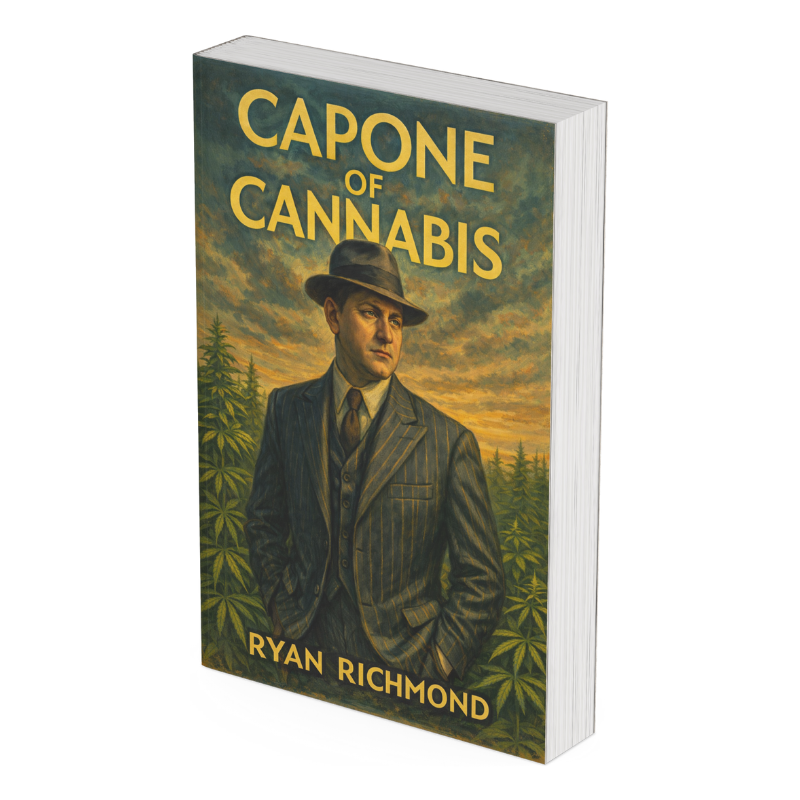
The following is not part of the book. You’ll learn when—and by whom—I was given the title Capone of Cannabis in the pages of the book.
Both Al Capone and I—Ryan Richmond—found ourselves drawn into outlaw industries that society wasn’t ready to accept, even as public opinion shifted. While Capone built his empire on bootleg alcohol during Prohibition, I entered the world of cannabis when Michigan legalized medical marijuana. Our motives weren’t born of rebellion, but rather of opportunity.
Unlike Capone, I didn’t smuggle product across borders or enlist gunmen to protect my turf. There were no Tommy guns or speakeasies in my story—just dispensaries, doctor recommendations, and a sincere belief that we were helping people. Yet, like Capone, I would end up with a federal prison number, targeted by agencies that had long lost their moral compass.
Al Capone’s downfall came not from murder or racketeering, but from taxes. The IRS took him down when all else failed. Nearly a century later, history would repeat itself. Despite being a state-sanctioned entrepreneur, I too would be labeled a criminal—not for violence, but for daring to participate in a system that the federal government still considered illegitimate.
My story is not one of glamor or glory. It is the journey of a pilgrim—a trailblazer into a legal gray zone, laying the groundwork for what would become one of the fastest-growing industries in America. But pioneers rarely prosper. Pilgrims get slaughtered so settlers can thrive.
We didn’t have roadmaps. We didn’t have laws that made sense. We had guts, grit, and the naive belief that if the state said we were legal, we were safe. We were wrong.
Opening a dispensary in Michigan in 2010 was like stepping into uncharted territory. We were the first to be licensed, and the first to be raided. I was a real estate professional by trade, helping doctors and lawyers find office space. Then came the call that changed everything: “Do you know any buildings for a marijuana dispensary?”
What I didn’t realize at the time was that the war on drugs wasn’t over—it had just changed uniforms. The DEA had handed off the baton to the IRS, the local narcotics units, and overzealous prosecutors looking to make names for themselves. We weren’t criminals. We were entrepreneurs caught in the crossfire of politics, policy, and paranoia.
This is my story. A story of ambition, betrayal, raids, and resilience. A story that parallels Capone’s not in violence, but in the quiet devastation that comes from being ahead of your time—and punished for it.